
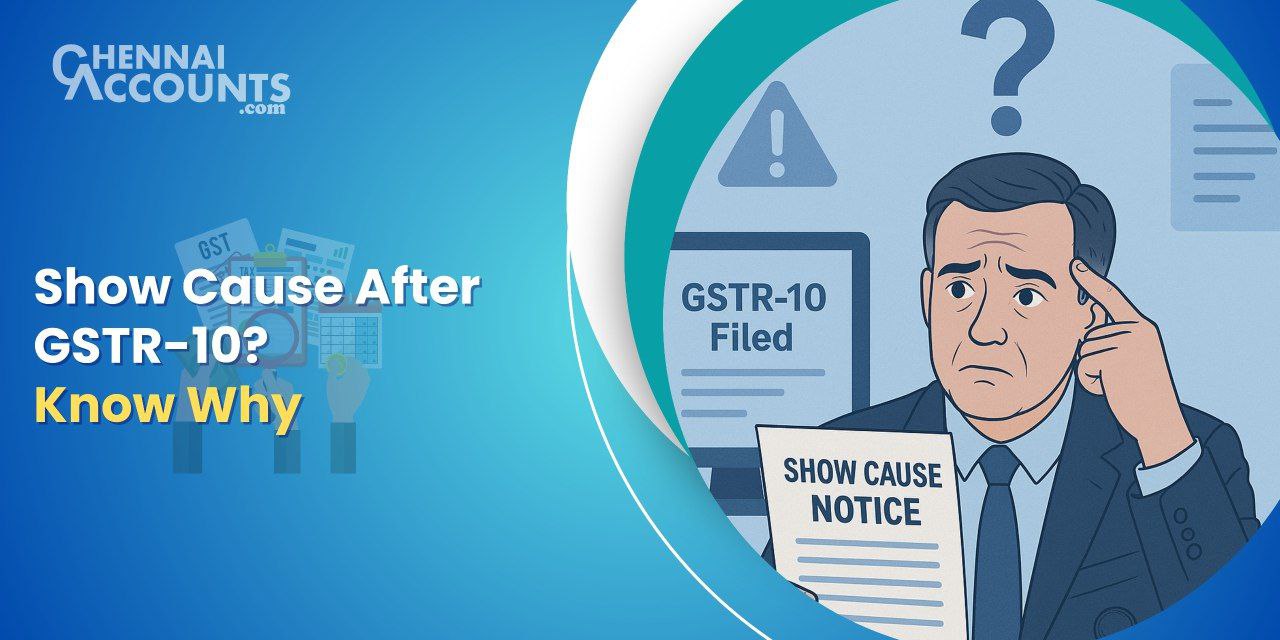
Filing your GSTR-10 might feel like a final step after cancelling your GST registration, but for many businesses, it’s just the beginning of another round of scrutiny. Many taxpayers are surprised to receive a Show Cause Notice for GST registration cancellation, even after submitting their GSTR-10. But why does this happen?
As a leading Gst Tax Consultant In Chennai, we’ve seen numerous cases where businesses unknowingly make errors during GSTR 10 filing, resulting in notices from the GST department. Let’s break down the common reasons behind such show cause notices and what you should do if you receive one.
What Is GSTR-10 and Why Does It Matter?
GSTR-10 is the final return you’ll need to file if your GST registration is cancelled or voluntarily given up. It covers things like your closing stock, any ITC reversals, tax liabilities, and other important compliance info. Filing this return accurately is crucial because it’s the last word from your business in the eyes of the tax authorities.
However, if the data in GSTR-10 doesn’t align with your past returns or if there are red flags, a show cause notice might be on its way.
Scenarios Where a Tax Officer May Issue a Show Cause Notice After Filing GSTR-10
Here are some common triggers that may prompt a tax officer to issue a show cause notice:
- Discrepancies in ITC Reversal
If you don’t properly reverse Input Tax Credit (ITC) on your closing stock, inputs, or capital goods, the officer may flag your return.
Example: If your closing stock is worth ₹10 lakh, but you reverse ITC only for ₹5 lakh, the officer will likely issue a show cause notice for GST registration to recover the remaining amount.
- Underreported or Pending Tax Liabilities
If your past returns (like GSTR-1 or GSTR-3B) indicate unpaid dues, the portal will auto-detect these inconsistencies. Filing GSTR-10 without clearing these dues can prompt a notice.
Example: If your previous returns show pending liability but you proceed with GSTR-10 anyway, expect a notice demanding full payment.
- Mismatch in Sales Turnover & Tax Paid
GST officers compare your GSTR-10 with earlier filings. Any mismatch in declared turnover or lower tax liabilities raises suspicion.
Example: GSTR-1 reflects ₹50 lakh in sales, but GSTR-10 shows ₹30 lakh — a clear mismatch that may trigger scrutiny.
- Non-Filing or Late Filing of GSTR-10
The law mandates GSTR-10 be filed within 3 months from cancellation. Failure to do so can result in an SCN under Section 46 of the CGST Act.
Example: If your business ceased operations in January 2025, GSTR-10 must be filed by April 2025. Miss this deadline, and you’re looking at a potential penalty.
- Non-Payment of Interest or Late Fees
If you’ve delayed earlier filings or missed paying late fees or interest, the officer can issue a notice demanding payment.
Example: GSTR-3B filed late multiple times? If dues are unpaid, a notice might be your next mail from the department.
- Failure to Provide Supporting Documents
Documents like ITC-03, stock details, and CA certificates (for ITC reversal exceeding ₹2 lakhs) may be requested. Failure to provide these leads to further action.
Example: Skipping the CA certificate for large ITC reversal is a surefire way to get noticed.
- Suspected Tax Evasion or Fraudulent Transactions
If there are suspicions of tax fraud — like fake invoicing or unusually high ITC claims without real business activity — officers will use SCNs as a tool to investigate.
Example: A business with large ITC claims and no real turnover is likely to get a show cause notice for deeper inquiry.
What to Do After Receiving a Show Cause Notice?
Getting a show cause notice can feel stressful, but don’t panic — what matters most is responding the right way, and on time.
- You usually get around 15 to 30 days to reply, so use that time wisely.
- Attach explanations and relevant supporting documents.
- If your response satisfies the officer, the notice can be withdrawn.
If not, expect penalties, additional tax liabilities, or even rejection of your GSTR-10.
Preventive Steps to Avoid Show Cause Notices
Whether you’re closing a business or transitioning to a new structure, it’s critical to take these steps:
- Reconcile all past GST returns before GSTR-10 filing.
- Settle pending dues, interest, and late fees.
- Review stock and ITC data with your accountant.
- Attach all required documents and certificates.
- Consult with our team to avoid show cause notices and stay compliant.
Conclusion: Avoid Show Cause Notices With Expert Help
Avoiding a show cause notice for GST registration is all about compliance. GSTR-10 is not just a formality — it’s a detailed statement that must match past returns, reverse ITC accurately, and clear dues fully.
At Chennai Accounts, we work closely with you on everything from GSTR-10 filing and GST registration in Chennai to helping you navigate tricky Accounting Services. Our friendly team makes sure you’re always compliant, so you don’t get stuck with penalties or surprise notices.
Whether you’re closing your business or just switching gears, partner with a reliable Gst Tax Consultant In Chennai, like Chennai Accounts, who understands the system and gets the work done right.
You May Also Like:
Leave A Comment