
India’s food safety ecosystem is going through a major overhaul, and one of the significant changes being made by the Food Safety and Standards Authority of India (FSSAI) is the compulsory registration of small food vendors selling food from the roadside. The decision ensures that food safety measures of good quality are observed, cleanliness standards are heightened, and customer confidence in local food vendors is increased.
It is no longer a matter of choice but a necessity to have FSSAI Registration for Roadside Food Stalls as a result of awareness being raised and stricter regulations being implemented.
This news integrates small vendors into the formal system, which in turn gives them protection, opportunities for business growth, and legal security.
Firstly, a number of local sellers and small outlet owners situated in metro cities are now looking for Food License Registration in Chennai as well as some directions on how to initiate the process without any problems. This blog involves everything: the recent FSSAI announcement, who is obligated to register, advantages, prerequisites, documentation, filing procedure, and how small vendors can be compliant without giving themselves a hard time.
What was the reason for FSSAI Mandating Roadside Food Stalls?
In general, FSSAI has been putting its effort to equip India with one standard of safety that would be met every time food is prepared and served in the country. Besides that, big restaurants and food factories are closely monitored; small vendors selling food from the roadside don’t have enough formal supervision. The recent update closes that gap.
Main reasons for the change:
- The number of street food stalls serving an enormous number of people is growing rapidly each day
- The frequency of food-related illnesses is increasing
- Requirement of hygiene, safety, and quality standards
- The need to bring unorganised food businesses under a certified system
- Customers safeguarding themselves from the consumption of unsafe or contaminated food
- The updated guidelines now emphasise that vendors at roadside food stalls must obtain FSSAI Registration to be allowed to operate in such a way that they are directly involved with consumers and thus have significant effects on public health.
Who Must Register Under the New FSSAI Rule?
The mandatory registration applies to:
- Tea stalls
- Juice shops
- Small tiffin centres that provide fresh, homemade meals to customers from day to day
- Chat and fast-food pushcarts that deliver fast, tasty snacks directly to the streets
- Food trucks with innovative dishes on wheels and an increasing fan base
- Roadside sandwich, dosa, or parotta vendors, where people take a break to eat cheap, tasty, and satisfying food
- Small bakeries or snack counters
- Street vendors selling cooked or packaged food
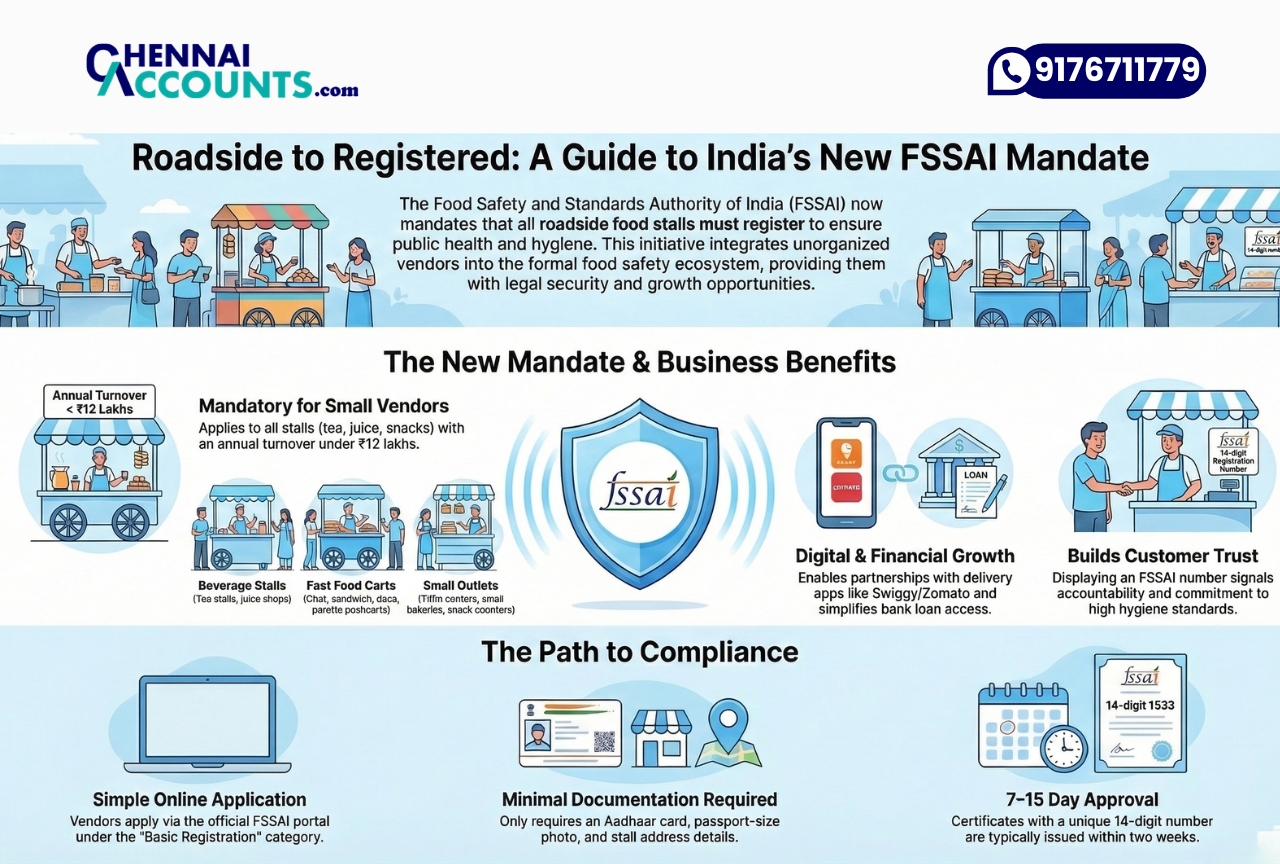
If your annual turnover is less than ₹12 lakhs, you are required to obtain an FSSAI Basic Registration. Vendors all over Tamil Nadu, particularly those looking for Food License Registration In Chennai, are now in a hurry to complete the formalities in order to stay away from penalties, inspection issues, and the risk of having their food stall shut down for non-compliance.
Benefits of FSSAI Registration for Small Roadside Vendors
Registration is not merely a compliance obligation – it offers major benefits:
✔ Builds Customer Trust
One of the most important factors is food safety. Customers are attracted to vendors displaying an FSSAI number. It is a sign of accountability and confirms the implementation of hygiene standards.
✔ Protects Against Legal Penalties
Registration-less operations may attract fines and closure notices these days.
✔ Helps Vendors Expand Their Business
With an FSSAI license, stalls can become suppliers to offices, events, cloud kitchens, and retail stores of small municipalities.
✔ Easy Access to Loans & Government Schemes
Banks generally prefer to extend credit to businesses that are registered rather than those that are unregistered
✔ Improves Food Safety & Hygiene Standards
Vendors get the rules for safe handling, storage, and preparation.
✔ Necessary for online delivery platforms
Delivery apps like Swiggy, Zomato, and Dunzo mandate FSSAI registration for all food partners.
Documents Necessary for FSSAI Registration of a Small Food Stall on the Roadside
In an attempt to make the procedure easier, FSSAI has cut down the documents needed for small vendors.
However, the essential documents must be clear and valid. The Documents Required for FSSAI Registration Small Food Stall include:
Basic Document Checklist:
- Aadhaar card of the stall owner
- Passport-size photograph
- Stall/shop address details
- The category of food being sold
- Mobile number & email ID
If necessary, additional documents might also be required:
- Lease agreement (if the area is leased)
- Business information (if a partnership)
- Food handling declaration
The majority of the new applicants who are looking for an FSSAI license online and apply online are often confused about the clarity of documents, the uploading format, and the accuracy. This causes their applications to be rejected or delayed. Make sure that your papers are always updated and kept in a condition that is easy to read.
FSSAI registration online is easy; you only need to be thorough with the steps, verify every detail of your work, and upload the documents that are clear so that you do not commit minor mistakes that can result in great delay.
- Visit the official FSSAI portal
This is where you must complete the registration.
- Select “Apply for Registration”
Choose the basic registration option for small food stalls.
- Enter personal & business details
Ensure the mobile number and email ID are active.
- Upload required documents
Incorrect or unclear uploads may lead to rejection.
- Submit the application
Once completed, you receive an acknowledgement number.
- Inspection (if required)
Some food stalls may undergo a quick inspection to verify basic hygiene practices.
- Receive the FSSAI Registration Certificate
Your certificate will contain a 14-digit FSSAI number. This must be displayed visibly at your stall.
Many vendors prefer professional help for Fssai license apply online because consultants verify the documents and ensure 100% correct filing.
Common Mistakes Small Vendors Should Avoid
- Submitting unclear or invalid documents
- Entering an incorrect stall address
- Choosing the wrong food business category
- Not checking email/SMS for FSSAI updates
- Ignoring renewal timelines
- Not displaying the FSSAI number at the stall
- If you stay far from these errors, your authorisation will be granted smoothly, and there will be no unnecessary delays.
Why FSSAI Registration is More Important Than Ever
With growing consumer awareness and digital payment usage, small food stalls are becoming more professional. Customers nowadays look for clean, reliable, and registered vendors even when buying street food.
The FSSAI update empowers small vendors to:
- Gain recognition
- Improve hygiene
- Build long-term customer trust
- Operate without legal risk
- This step marks a major shift toward safer food practices across India.
Quick Summary: Why Roadside Food Stalls Must Register Now
- It is now mandatory under FSSAI’s updated rules
- Protects vendors from penalties
- Boosts business credibility
- Helps secure loans and supply deals
- Essential for online delivery partnerships
- Helps to maintain the food standard and keep the food hygienic
- Requires simple documents like Aadhaar and stall details
Conclusion
Small food vendors have the opportunity to raise their hygienic standards, win the trust of customers, and expand their business in a legal way by following the new FSSAI regulations. If you have a tea stall, tiffin centre, or sandwich shop, getting an FSSAI registration on time is a must for safety and meeting the rules. Local Food Businesses can take the help of expert guidance from Chennai Accounts for quick, easy registration and document support, to stay protected and progress with confidence.
FAQ
- Do all food stalls on the roadside need to have an FSSAI registration?
The FSSAI rules made it clear that at least a basic FSSAI registration must be done for all kinds of local food vendors, that is to say, tea stalls, sandwich shops, fast-food carts, juice shops, and tiffin-centres. Even if your yearly turnover is less than ₹12 lakhs, you should still register to run a lawful business and ensure the safety of customers.
- How long is the waiting period for a small vendor’s FSSAI registration certificate?
It is a typical scenario that a basic FSSAI registration for a small stall takes 7-15 days to be completed if all the documents are in proper order. Delay in the process is mostly due to the wrong uploading of documents or the inaccurate selection of the business category. To get approval quickly, one can take the assistance of a professional.
- Are small vendors mandated to renew their FSSAI registration annually?
Yes. Normally, FSSAI Basic Registration is valid from one to five years and it depends on the vendor’s choice at the time of the application. The vendor has to renew his registration before the expiration date if he wants to avoid the issuance of a fine and business stoppage.
Leave A Comment