
India’s GST system has matured significantly since its launch, but every year brings regulatory adjustments that businesses must adapt to. The Major GST Changes in 2026 focus on improving compliance transparency, expanding digital monitoring, and strengthening tax reporting accuracy. For businesses, professionals, and startups, understanding these changes is not just about compliance — it’s about avoiding penalties and running smoother financial operations.
Recent tax data also shows that GST compliance is improving across the country. According to official GST Network figures released on 1 March 2026, India recorded ₹1,83,609 crore in GST collections for February 2026. This reflects strong economic activity and improved reporting discipline among taxpayers.
In this detailed guide from Chennai Accounts, we break down the Major GST Changes in 2026, explain the latest GST collection trends, and share practical insights that every taxpayer should know.
GST Collections February 2026: A Quick Snapshot
Strong GST collections often indicate growing economic activity and better compliance. The February 2026 GST revenue figures reveal steady performance across sectors.
|
GST Indicator |
Amount |
|
Gross GST Collection (Feb 2026) |
₹1,83,609 crore |
| January 2026 Collection |
₹1,93,384 crore |
|
February 2025 Collection |
₹1,69,779 crore |
| Year-on-Year Growth |
8.1% |
|
Net GST Collection |
₹1,61,014 crore |
|
Net Growth |
7.9% YoY |
Tax Component Breakdown
|
Component |
Amount |
|
CGST |
₹37,473 crore |
|
SGST |
₹45,900 crore |
|
IGST |
₹1,00,236 crore |
| Total Refunds |
₹22,595 crore |
A closer look at the numbers reveals two notable trends:
- Domestic transactions increased 5.3% year-on-year
- GST revenue from imports grew 17.2%
These figures indicate stable consumer demand and consistent compliance across industries.
State-wise GST Performance
GST revenue data also highlights how different states contribute to the national tax pool.
Top GST Contributing States
|
Rank |
State |
|
1 |
Maharashtra |
|
2 |
Karnataka |
|
3 |
Gujarat |
|
4 |
Uttar Pradesh |
|
5 |
Tamil Nadu |
Among these, Karnataka recorded around 11% growth, while Gujarat and Maharashtra showed steady expansion.
Some smaller states and territories also recorded remarkable growth.
High-Growth Regions
|
Region |
Growth |
| Other Territory |
94% |
|
Sikkim |
26% |
| Haryana |
23% |
|
Meghalaya |
10% |
However, a few regions saw declines in post-settlement revenue, including Jharkhand and Chhattisgarh.
Overall, the February 2026 GST collections reinforce the strength of India’s tax base and improving compliance levels.
Major GST Changes in 2026
Beyond revenue performance, businesses must understand the Major GST Changes in 2026 that affect compliance, invoicing, and tax reporting.
These updates are largely driven by the government’s push toward digital monitoring and fraud prevention.
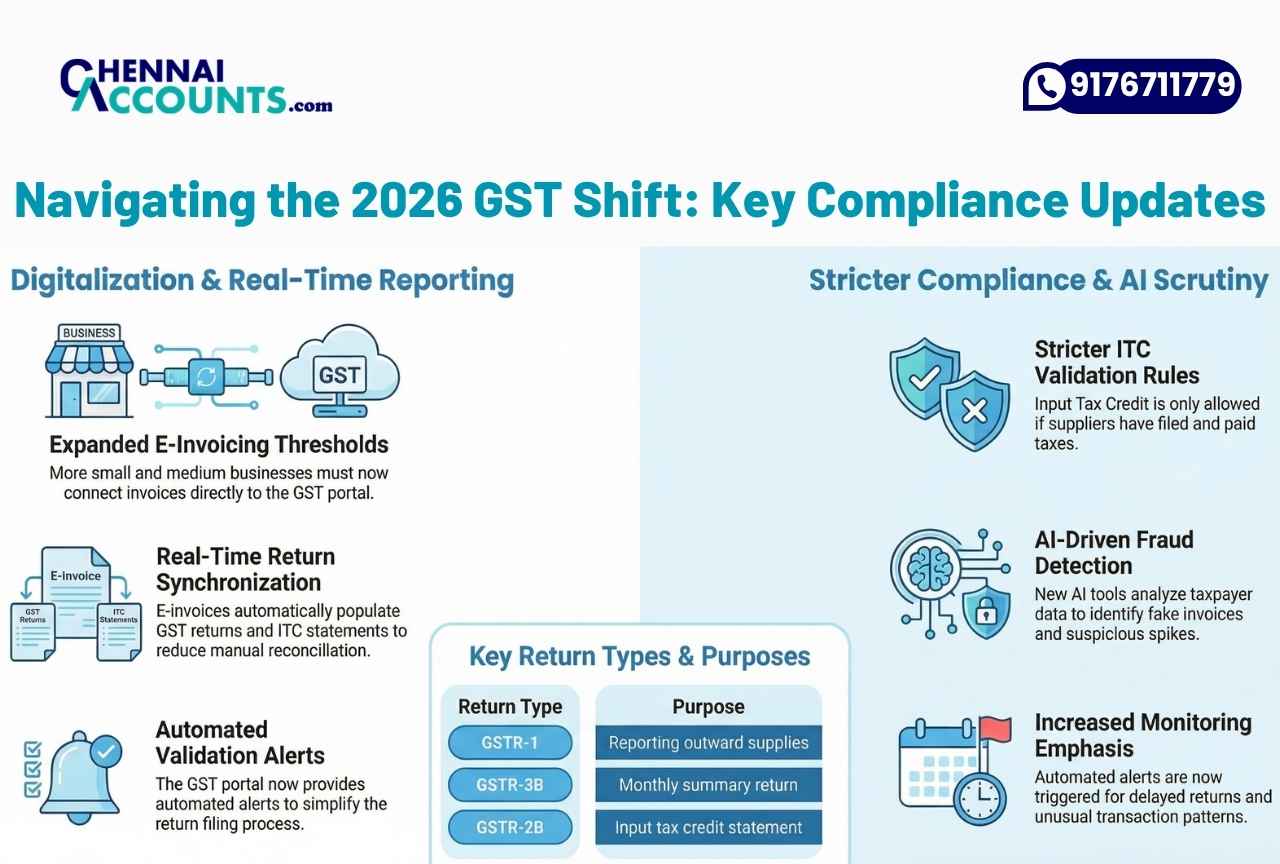
1. Expanded E-Invoicing Requirements
One of the most significant Major GST Changes in 2026 is the expansion of mandatory e-invoicing.
Previously applicable mainly to large businesses, the threshold has now been lowered, bringing more small and medium businesses into the e-invoicing system.
Why this matters
E-invoicing connects invoices directly to the GST portal through the Invoice Registration Portal (IRP). Once generated, invoices automatically update the GST system.
Benefits for businesses
- Reduced risk of invoice mismatches
- Faster return filing
- Improved transparency in tax reporting
Businesses entering the GST system for the first time usually begin with proper compliance through Gst Registration In Chennai.
2. Real-Time Invoice Reporting
Another important shift in GST Changes in 2026 is faster invoice synchronization with the GST portal.
In practical terms, invoices generated through e-invoice systems automatically populate GST returns and ITC statements.
What this means for businesses
- Reduced manual reconciliation
- Faster data verification
- Improved supplier-buyer transparency
Businesses that still rely on manual bookkeeping may face difficulties adapting to these systems. Many companies now use professional Accounting Services In Chennai to streamline digital accounting and GST reporting.
3. Stricter Input Tax Credit (ITC) Validation
Input Tax Credit continues to be one of the most sensitive areas in GST compliance. The Major GST Changes in 2026 introduce tighter ITC verification rules.
Updated ITC Conditions
A business can claim ITC only if:
- The supplier has filed GST returns
- The invoice appears in the buyer’s GSTR-2B
- The tax has been paid to the government
If any of these conditions fail, the tax credit may be disallowed.
Because of these stricter rules, many businesses rely on experienced Gst Consultants Chennai to monitor ITC reconciliation and vendor compliance.
4. AI-Based GST Monitoring
The government has significantly strengthened its compliance monitoring systems. One of the most notable Major GST Changes in 2026 is the introduction of AI-driven scrutiny tools.
These systems analyse taxpayer data to detect unusual patterns.
The system can identify
- Fake invoice networks
- Abnormally high ITC claims
- Suspicious transaction spikes
- Vendor chains involved in tax evasion
For businesses, this means compliance errors are now detected much faster than before.
5. Simplified GST Return Filing
Many taxpayers frequently ask what are the new GST rules in 2026 India, especially regarding GST return filing.
The GST portal now includes several improvements designed to simplify the process.
Key Updates
- Auto-population of return data
- Faster ITC reconciliation
- Automated validation alerts
- Improved dashboard tracking
Updated GST Return Structure
|
Return |
Purpose |
|
GSTR-1 |
Reporting outward supplies |
|
GSTR-3B |
Monthly summary return |
|
GSTR-2B |
Input tax credit statement |
These changes reduce manual work while improving reporting accuracy.
6. Increased Compliance Monitoring
Authorities are placing greater emphasis on compliance under GST Changes in 2026.
Businesses may now receive automated alerts for issues such as:
- Delayed GST returns
- Invoice mismatches
- Unusual ITC claims
Maintaining organized financial records is more important than ever.
Businesses with large employee bases often integrate tax and payroll reporting through professional Payroll Consultants In Chennai.
GST Compliance Checklist for 2026
To adapt to the Major GST Changes in 2026, businesses should focus on a structured compliance strategy.
|
Compliance Area |
What Businesses Should Do |
|
Invoice Management |
Adopt e-invoice compatible software |
| Vendor Verification |
Ensure suppliers file GST returns |
|
ITC Reconciliation |
Conduct monthly verification |
| Return Filing |
File returns before deadlines |
|
Documentation |
Maintain digital audit records |
Following these practices can significantly reduce compliance risks.
Industries Most Affected by GST Changes
The Major GST Changes in 2026 will affect industries differently depending on their transaction volumes and compliance structures.
Small Businesses
- More compliance due to e-invoice expansion
- Need for better accounting systems
Manufacturing Companies
- Greater scrutiny on supply chain ITC claims
Service Providers
- Faster digital reporting requirements
Food businesses starting operations must also manage regulatory compliance alongside GST processes, including Fssai Registration Chennai.
Practical Tax Tips for Businesses in 2026
From a practical perspective, businesses should approach GST compliance strategically rather than reactively.
- Automate accounting processes
Manual bookkeeping often leads to reporting errors. - Conduct periodic GST health checks
Quarterly reviews help identify compliance gaps early. - Maintain vendor compliance records
Always verify whether suppliers file GST returns before claiming ITC. - Maintain proper documentation
Organized records make GST audits far easier. - Align GST with overall tax planning
Businesses should coordinate GST management with broader tax responsibilities such as Income Tax Filing In Chennai.

FAQs
1. What GST changes are happening in 2026?
A few updates are coming in 2026. More businesses will need to move to e-invoicing, and the government is tightening checks on Input Tax Credit claims. They’re also using AI tools to spot suspicious transactions. On the plus side, the GST portal itself has been improved to make return filing a bit smoother.
2. Do small businesses have to use e-invoicing now?
Some of them might. The turnover limit has been reduced, so businesses that didn’t need e-invoicing earlier could now fall under the rule. If your business is growing, it’s worth checking whether the new limit applies to you.
3. Why are GST collections increasing lately?
A big reason is better compliance. More businesses are filing their returns properly, and digital tracking has made tax reporting harder to avoid. Stable economic activity is also helping push collections up.
4. Which states contribute the most GST?
Maharashtra usually brings in the highest GST revenue. After that, states like Karnataka, Gujarat, Uttar Pradesh, and Tamil Nadu also contribute a large share.
5. How can businesses stay away from GST penalties?
The basics really help here. File returns on time, keep your records and invoices organised, and make sure your suppliers are also filing their GST returns properly. When everything is documented correctly, penalties are much easier to avoid.
Final Thoughts
The Major GST Changes in 2026 reflect India’s shift toward a more transparent and technology-driven tax system. With AI monitoring, stricter ITC validation, and expanded e-invoicing requirements, businesses must be more disciplined in their compliance practices.
At the same time, strong GST collections — including ₹1.83 lakh crore in February 2026 — highlight the steady growth of India’s tax ecosystem.
Businesses that stay informed, adopt digital accounting systems, and seek professional support will be better positioned to navigate the evolving GST landscape. Our Chennai Accounts continue to help businesses simplify compliance and manage GST responsibilities efficiently in an increasingly complex tax environment.
Leave A Comment