Protect your brand name, logo, and slogan with a registered trademark under the Trade Marks Act, 1999 — handled end-to-end by our experts.
Proven expertise in trademark registration, objection handling, and brand protection under the Trade Marks Act, 1999.
Got my brand name trademarked in under 8 months. ChennaiAccounts handled the filing, objection reply, and everything. Truly professional service.
My logo is now officially registered. The team guided me on the right trademark class and handled the TM-48 and all documents. Very smooth process.
As an MSME we got the 50% government fee benefit. ChennaiAccounts ensured our Udyam certificate was correctly submitted. Excellent service.
ChennaiAccounts registered the trademark for our clothing brand under Class 25. Fast, affordable and stress-free. Highly recommended for startups.
Got my brand name trademarked in under 8 months. ChennaiAccounts handled the filing, objection reply, and everything. Truly professional service.
My logo is now officially registered. The team guided me on the right trademark class and handled the TM-48 and all documents. Very smooth process.
As an MSME we got the 50% government fee benefit. ChennaiAccounts ensured our Udyam certificate was correctly submitted. Excellent service.
ChennaiAccounts registered the trademark for our clothing brand under Class 25. Fast, affordable and stress-free. Highly recommended for startups.
Registered our company logo and tagline as a trademark. ChennaiAccounts advised us on the right class and handled the opposition perfectly. Outstanding.
Received my trademark certificate after a smooth process. They handled the objection letter expertly. All done online without visiting any office. Great team.
We registered trademarks under multiple classes for our brand. ChennaiAccounts guided the entire multi-class process flawlessly. Very knowledgeable team.
Trademark renewal was done quickly and on time. ChennaiAccounts reminded us well before the expiry date and handled all filings. Excellent support.
Registered our company logo and tagline as a trademark. ChennaiAccounts advised us on the right class and handled the opposition perfectly. Outstanding.
Received my trademark certificate after a smooth process. They handled the objection letter expertly. All done online without visiting any office. Great team.
We registered trademarks under multiple classes for our brand. ChennaiAccounts guided the entire multi-class process flawlessly. Very knowledgeable team.
Trademark renewal was done quickly and on time. ChennaiAccounts reminded us well before the expiry date and handled all filings. Excellent support.
Trademark registration in India is open to any individual or legal entity that intends to use a unique brand name, logo, or symbol for business or commercial purposes. Both Indian and foreign applicants are eligible to file a trademark application online through the official government portal.
An applicant can file a trademark even before starting the business, as long as there is a genuine intention to use the mark in the future.
Grants you the legal right to use your brand name or logo nationwide
Enables you to take legal action against brand misuse or duplication
A trademark is intellectual property that can be sold, licensed, or franchised
Acts as valid proof of brand ownership in courts and disputes
Facilitates national and international brand recognition and growth
Trademarks are categorized based on the nature of the mark and the type of protection they provide. Registering the correct type of trademark ensures proper legal coverage for your brand identity.
Used for unregistered trademarks. Indicates that a brand name, logo, or slogan is claimed as a trademark. Commonly used when the trademark application is filed but not yet registered. Can be used by anyone without legal approval.
Used for unregistered service-based businesses. Represents services instead of products. Used by IT firms, consultants, law firms, and service providers. Not commonly used in India but recognized internationally.
Used only after the trademark is officially registered. Indicates full legal protection under the Trade Marks Act, 1999. Grants the owner exclusive legal rights. Unauthorized use of ® without registration is legally punishable.
| Symbol | Registration Status | Legal Protection | When to Use |
|---|---|---|---|
| ™ | Not Registered | Limited | After application filing |
| ® | Registered | Full Legal Protection | After registration certificate |
Protects the brand name, business name, or slogan in text form, without considering any design or logo. Example: Tata, Amazon, Infosys.
Protects the visual representation of a brand, including logos, symbols, and artistic designs. Covers the unique graphical identity of your business.
Used to identify and protect services rather than physical products. Example: IT services, legal services, consulting, education.
Applied to trademarks used for physical goods or products to distinguish them from competitors in the marketplace.
Owned by an association or group and used by its members to indicate common characteristics or standards. Example: Marks used by trade associations.
Indicates that goods or services meet specific quality standards or certifications. Example: ISI Mark, ISO Certification Marks.
Protects distinctive audio identity associated with a brand. Example: Startup sounds or brand jingles that uniquely identify a company.
Protects the unique shape of a product or its packaging. Example: Distinctive bottle shapes that are uniquely associated with a brand.
Protects a unique repeating pattern used consistently on products as a brand identifier.
Protects specific combinations of colors that uniquely identify a brand, subject to distinctiveness criteria under the Trade Marks Act.
Transparent pricing with no hidden charges. Inclusive of Government Fees. Choose the plan that suits your business.
For Proprietorship
Inclusive of Government Fee
For LLP, Partnership & Companies with MSME
Inclusive of Government Fee
For LLP, Partnership & Companies without MSME
Inclusive of Government Fees
To file a trademark application online, the applicant must submit specific documents based on the type of entity. Incorrect or incomplete documents may lead to application rejection or objection.
For Individuals / Proprietors
PAN Card & Aadhaar Card
For Partnership Firms
Partnership Deed, PAN Card of the Firm, Authorization Letter
For LLPs & Companies
Certificate of Incorporation, PAN Card of the Company, Board Resolution (if required)
For Trusts & Societies
Trust Deed / Society Registration Certificate
For Startups & MSMEs (For Fee Benefits)
DPIIT Startup Certificate & Udyam (MSME) Registration Certificate
For Foreign Applicants
Passport / Incorporation Certificate, Address Proof, Authorization in favour of Indian Trademark Attorney
Selecting the correct trademark class is one of the most critical steps in the trademark registration process. In India, trademarks are classified under the Nice Classification System, which consists of 45 different classes — Classes 1 to 34 for goods and Classes 35 to 45 for services. A trademark is protected only within the class or classes in which it is registered, making accurate classification essential for effective legal protection.
Electronics, software, mobile apps
Clothing, footwear, headgear
Advertising, business management, e-commerce
Education, entertainment, training
IT services, SaaS, software development
Hotels, restaurants, catering services
For manufacturing, trading, or physical products — chemicals, pharmaceuticals, cosmetics, machines, food products, beverages, clothing, electronics, and more.
For service-based businesses — advertising, education, legal, medical, IT, software, hospitality, travel, and consultancy services.
If your business operates in more than one category, you must apply under multiple trademark classes to ensure complete protection. Example: A clothing brand that also runs an e-commerce platform may need to register under Class 25 (clothing) and Class 35 (online retail services).
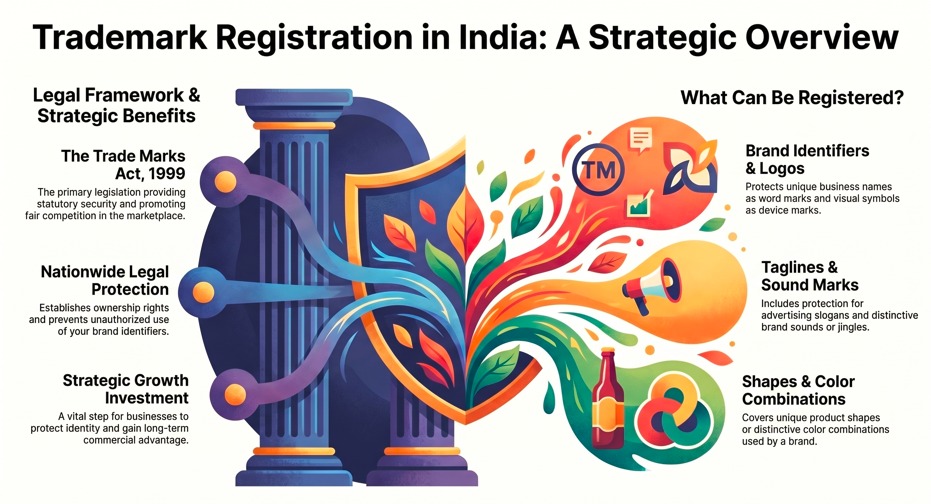
Trademark Registration is the legal process of securing exclusive rights over a brand name, logo, tagline, symbol, or any unique identifier that represents a business or its products/services. In India, trademark registration is governed by the Trade Marks Act, 1999 and administered by the Office of the Controller General of Patents, Designs & Trade Marks (CGPDTM).
Once registered, a trademark provides nationwide legal protection, prevents unauthorized use, and establishes ownership rights over the brand. It is a vital step for businesses aiming to protect their identity, build brand value, and gain long-term commercial advantage.
Registering a trademark is not just a legal formality — it is a strategic investment in your brand's long-term security, growth, and commercial success.
The Trade Marks Act, 1999 is the primary legislation governing trademark registration, protection, enforcement, and legal remedies in India. The Act was enacted to provide statutory security to brand owners, prevent trademark infringement, protect consumers from deception, and promote fair competition in the marketplace. It replaced the earlier Trade and Merchandise Marks Act, 1958, and came into force on 15 September 2003. The Act aligns Indian trademark laws with international standards under the TRIPS Agreement (Trade-Related Aspects of Intellectual Property Rights), making India's trademark regime globally compliant.
Protect your unique business or product name as a word mark
Register your brand logo or visual symbol as a device mark
Protect your brand tagline or advertising slogan
Protect a distinctive brand sound or jingle
Unique product shapes or distinctive colour combinations
Once a trademark is successfully registered, certain post-registration procedures and responsibilities must be followed to ensure continuous legal protection and effective brand enforcement. Trademark registration is not a one-time activity; it requires ongoing compliance and strategic management.
After registration, the trademark owner must use the ® symbol with the brand name or logo to indicate full legal protection and exclusive ownership rights.
Regularly monitor the market and online platforms to detect unauthorized use, counterfeiting, and brand imitation. Timely legal action maintains trademark strength.
Trademark registration is valid for 10 years. Must be renewed every 10 years. Renewal can be filed before expiry or within the grace period with penalty. Non-renewal may result in removal from the register.
A registered trademark can be sold, assigned, licensed, or transferred. Such changes must be legally recorded with the Trademark Registry to remain valid.
Owners may allow third parties to use their trademark through a license agreement, enabling brand monetization without losing ownership.
Any change in business address, legal ownership, or company structure must be updated with the Trademark Registry to avoid compliance issues.
If any error appears in the Trademark Register after registration, rectification applications can be filed for correction of the official record.
If infringement is detected, the trademark owner can take civil action for damages, criminal action for counterfeiting, injunction orders, and seizure of infringing goods.
Trademark registration in India is valid for a period of 10 years from the date of application. To continue enjoying legal protection, exclusive ownership, and enforcement rights, the trademark must be renewed every 10 years. The renewal process ensures that the trademark remains active and enforceable without interruption.
Failure to renew the trademark within the prescribed time may result in removal of the trademark from the Register, leading to loss of legal rights.
The trademark owner or authorized agent must file Form TM-R with the Trademark Registry for renewal.
The applicable renewal fee must be paid as prescribed by the government.
The Registry verifies the renewal application and supporting details.
Upon successful verification, the trademark is renewed for another 10 years and updated status is reflected in the Trademark Register.
Restoration of Removed Trademark: If a trademark is removed due to non-renewal, the owner can apply for restoration within 1 year from the date of removal, along with heavy government penalties and justification.
Trademark Rectification and Cancellation are legal remedies provided under the Trade Marks Act, 1999 to correct errors in the Trademark Register or to remove a wrongly registered trademark. These provisions ensure that only valid, lawful, and genuinely used trademarks continue to enjoy statutory protection.
Trademark rectification refers to the correction, modification, or alteration of details recorded in the Trademark Register. It is applicable when there is any error, omission, or incorrect entry related to a registered trademark.
Trademark cancellation refers to the complete removal of a registered trademark from the Trademark Register. It is initiated when a trademark is found to be invalid or is no longer legally entitled to protection.
Application is filed in Form TM-O with the Trademark Registry.
Detailed legal grounds with supporting documents are submitted.
The affected party is issued a formal notice.
The respondent files a reply to the allegations.
Both parties present evidence and arguments before the authority.
The Registrar passes an order for rectification, cancellation, or rejection.
Trademark infringement occurs when an unauthorized person or business uses a registered trademark — or a deceptively similar mark — in relation to goods or services in a manner that causes confusion among the public. Under the Trade Marks Act, 1999, infringement is a serious legal offence.
Trademark infringement takes place when a third party, without permission: uses an identical or deceptively similar trademark; uses the mark in the same or related class of goods/services; causes customer confusion or deception; or takes unfair advantage of the reputation of the registered brand.
Occurs when an identical or similar mark is used without authorization in relation to registered goods or services.
Occurs when a person knowingly assists, induces, or contributes to trademark misuse (e.g., distributors of counterfeit goods).
| Basis | Infringement | Passing Off |
|---|---|---|
| Registration | Requires registered trademark | Can apply to unregistered marks |
| Legal Right | Statutory right | Common law right |
| Burden of Proof | Relatively easier | More difficult |
| Remedies | Civil & criminal | Mainly civil |
Trademark infringement cases involve technical legal interpretation, evidence collection, court procedures, and interim relief and injunctions. Professional legal assistance ensures faster relief, proper enforcement, and maximum protection of brand rights.
Who Can File an Infringement Case? Registered trademark owner; authorized licensee or assignee; legal heirs of trademark owner.
We take the complexity out of trademark law so you can focus on building your brand.

Join 1,000+ brands that trust ChennaiAccounts for trademark registration. Get expert guidance, fast processing, and complete brand protection support.
